
Flutter vs. Dart: which is best for App development and why
Mobile app development has become a brand name when an app customer uses a mobile app, and it is easy to use; when more users use the app, it increases the reputation of the company,
makes the app, and also other competitors try to use the same technologies to improve their importance as well. Now the question arises about which technology is best for making a
customer-friendly app. This article aims to choose Flutter vs. Dart, the best one, and why. Also, I will tell you about the differences in why we chose both Google technologies for different
purposes.
Here I will tell you about two app development frameworks that can meet your requirements: Flutter and Dart. You may quickly learn about app development methodologies’ capabilities and advantages before deciding which would best suit your App’s concept.
What is Flutter?
As I told you in my previous article, Flutter for App Development, Google launched the open-source Flutter framework for building mobile apps. Due to its performance and ease of
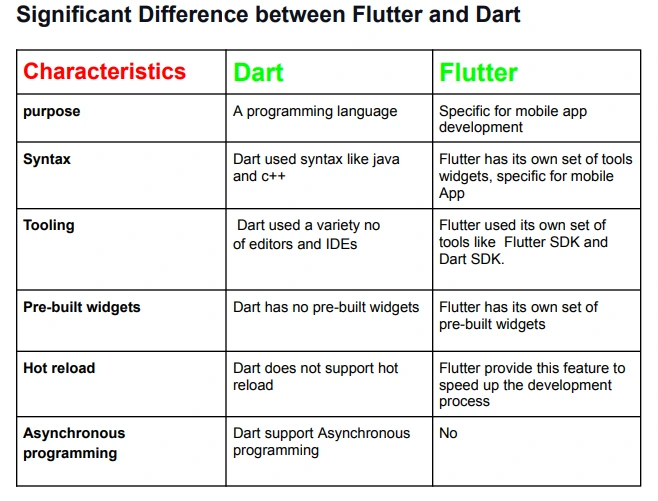
use, it has grown significantly in popularity among developers since its initial release in 2017. Support for hot reload is one of Flutter’s standout features. Developers may change their code
without completely rebuilding the application and immediately see the consequences. That can shorten the time it takes to debug and resolve problems while dramatically speeding up the development process.
A portable user interface toolkit with a considerable number of widgets and functionality is called Flutter. It provides a platform for programmers to quickly produce and share attractive, native applications for many platforms. Moreover, Flutter is in high demand in the software sector.
Core Features of Flutter Framework :
- Simple development tool interfaces
- Quick turnaround times
- Cross-platform support
- Vital Google-provided backing
Advantages of using Flutter:
- High-performance mobile applications can be developed using the quick and lightweight Flutter development framework.
- Flutter gives programmers many features and resources to build complex user interfaces and animations.
- Flutter makes it possible for better user and app interaction.
- Flutter offers a better user experience for users with fast internet connections since it is more responsive than conventional mobile apps.
- The user interfaces for iOS and Android are identical.
With Flutter, developers can pick up many new skills and develop alongside the platform’s dynamic developer community. It improves the efficiency and productivity of coders in terms of project cost and time.
What is Dart?
Before Flutter, Dart was another Google project that debuted version 2.1 in November. The Flutter community needs to be more extensive than ReactNative, Ionic, or Xamarin. As I described in the previous article, Dart Language for Programming Dart is a console, open-source, and object-oriented language that allows the developer to develop a range of valuable features to make software according to client needs.
It is a client-side programming language that offers a wide range of app development tools, including classes, an interface, several design features, dynamic typing, and optional typing—dart design for servers and web browsers.
Dart has a BSD license and is recognized by the ECMA standard. It has class-based grammar and is a garbage-collected language.
Dart has its package management, called Pub, which sets it apart from other programming languages. Pub is a tool that developers may use to build Flutter and Dart applications.
Core Features of Dart Framework :
- The statically typed Dart language enables strong typing.
- Dart’s extensive API library makes it simple to create software.
- Thanks to the Dart: io library, the database, and other external services are easy to access.
- Developing web apps in Dart is simple, thanks to the Dart: web library.
- Dart is open-source and cost-free.
Advantages of using Dart:
- Dart is appropriate for applications with complex logic since it is clear and straightforward to read.
- Dart features a clear syntax that simplifies writing and managing code.
- Dart is a good choice for high-performance applications because of its speed and effectiveness.
- Because Dart allows object-oriented programming, complex code structures are simple.
FAQs
What is Flutter?
Accessible UI SDK
What is Dart?
Language for developing client-side web and mobile applications
What characterizes Flutter from Dart, as well as what connects them?
Google’s Flutter cross-platform SDK and Dart, a programming language it also developed, are both open-source and free to use—the Flutter framework is designed for use with Dart.
Conclusion
Now it will be easy to decide which to use according to your requirements. Flutter vs. Dart comparison is to make things easy for you to make the best decision. Flutter is an Open-Source UI SDK that allows iOS/Android app development and uses Dart for programming.
Dart is an Open-Source language that is easy to learn, stable, and creates high-performance applications.
Now you know the features and advantages of two industry-leading app development tools, Flutter and Dart. Make sure whatever you choose meets your requirements.
Company Profile


